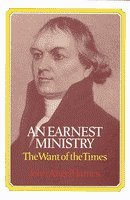
“The friends of evangelical doctrine, and the advocates of orthodoxy, have the following objects to keep ever in view in this age; they must take care of their Bibles, that they be not mutilated or curtailed by lawless criticism; they must take care of their theology, that it be not perverted by false philosophy; and they must take care of their pulpits, that they be not occupied by heretical, unspiritual, or incompetent ministers.” Thursday, April 15, 2010
John Angell James on Keeping Watch
“The friends of evangelical doctrine, and the advocates of orthodoxy, have the following objects to keep ever in view in this age; they must take care of their Bibles, that they be not mutilated or curtailed by lawless criticism; they must take care of their theology, that it be not perverted by false philosophy; and they must take care of their pulpits, that they be not occupied by heretical, unspiritual, or incompetent ministers.” Tuesday, April 13, 2010
Itching Ears
This powerful warning from John Angell James in his valuable book, An Earnest Ministry“The prevailing disposition, therefore, to do such homage to talent, rather than to moral excellence, is only another species of idolatry, more refined and subtle than the worship of stocks and stones, but scarcely less guilty…But when the Christian public is so enamoured of talent, as to admire it more than he message, which it is employed to set forth; when no preacher can be heard with pleasure or even endurance, however sound his doctrine, clear his statements, impressive his manner, or earnest his address, unless his discourse is radiant with the light of genius, and gay with the flowers of rhetoric; when truth itself is unpalatable unless it is sweetened with the honey of human eloquence, and even error so sweetened is swallowed for the sake of its luscious accompaniment; when the hearer of a sermon turns from it with disgust, because it fails to regale his fancy by the brilliancy of its images, or to lull his ear by the smoothness and harmony of its periods; when this is the state of the public taste, and it is to be feared that to a great extent it is the state of it now, surely it is time to call the attention of our congregations to something higher and better.” (250-251)
Tuesday, April 29, 2008
Oversight and Preaching
By ‘earnestness’ James means what today- due greatly to the influence of John Piper- would be dubbed ‘passion.’ He calls for a whole-hearted devotion to the labor of saving souls, which he is careful to define as including both seeing people come to faith and laboring for their sanctification so that they persevere (previous comment on this point).
Of such earnestness James also writes:
“Good preaching and good shepherding are quite compatible with each other, and he who is in earnest will combine both.” (149)This is a needed point. If we are in earnest about the salvation of souls we must labor in the teaching of the Word and in the careful oversight of the souls of our flock. These two activities cannot rightly be divorced. Careful oversight may not make us famous since people cannot download our oversight onto their iPods, but our preaching cannot be what it ought to be without this oversight.
Wednesday, September 26, 2007
Helpful Books on Evangelism
Directly on the topic:
Horatius Bonar, Words to Winners of Souls
Thomas Boston, The Art of Manfishing
Iain Murray, Spurgeon Vs Hyper Calvinism: The Battle for Gospel Preaching
Ichabod Spencer, A Pastor’s Sketches
C. H. Spurgeon, The Soul Winner
Pastoral Ministry Books which address this topic:
Richard Baxter, The Reformed Pastor
John Angell James, An Earnest Ministry
Biographies:
Elisabeth Elliot, Shadow of the Almighty: The Life and Testament of Jim Elliot
Michael McMullen, God's Polished Arrow: W.C. Burns
Share some that have been helpful to you.
Thursday, April 13, 2006
John Angell James on a Learned Ministry

Here is one more post from James’ An Earnest Ministry
James has no place for anti-intellectualism. He repeatedly holds up the value of learning.
“God forbid we should ever be afflicted by so great an evil as an unlearned one[ministry]” (27).Then, one of my favorite quotes is one that James borrows from a Dr. Wiseman:
“All other things being equal, he is likely to be the most useful preacher, who is the most learned one.” (50)
“A minister . . . can never have too much knowledge.” (50)
“If God hath no need of our learning, he can have still less of your ignorance.” (51)
Well put! However, if James has no place for anti-intellectualism, neither does he have any place for mere intellectualism- the idea that learning is an end in itself.
“Learning as an ultimate object and for its own sake, is infinitely below the ambition of a holy and devoted servant of Christ; but learning employed to invigorate the intellect, to enrich the imagination, to cultivate the taste, to give power to thought, and variety to illustration; to add to the skill and energy with which we wield the weapons of our warfare, is in some cases indispensable, and in all invaluable.” (55)
Learning is a tool which we should make use of as much as possible in order to be all the more useful in the proclamation of the gospel. Next, I give here a long quote, knowing that many will not choose to read it. However, I include it because it states so well the danger of the errors on both side (anti-intellectualism & mere intellectualism) and calls for the right path.
“We trust that among the rising ministry no one will allow himself to be tempted to the task for the mere reputation of learning. The real value of learning, in the estimate of a faithful servant of Christ, lies solely in the use that can be made of it. He who employs time and toil in rendering himself a learned man, which employed otherwise, would more effectually render him a useful man, is unfaithful to his Master. There are few things more important than the right appreciation of learning. There are some who spend their whole lives in acquiring it, in amassing hoard upon hoard; as it were the object of life to try how much may be got in a given time; not how much good may be done with it, or to what uses it may be turned as it is acquired. It is get, get, get; all getting and no giving. This is of a piece with the mania by which some are possessed in the mercantile world, the mania of money-making: with whom life’s problem is, how they may die rich, how much they can be worth in the world, before the moment comes when they must leave it. There is one material difference between the two cases; and, strange to say it is in favour of the rich rather than of the learned man. The rich man leaves his amassed treasures behind him; so that, although to himself they have been of little use while he lived, and now are of none, thy are not lost; others may use them, and use them well. But he, who has been acquiring learning all his days without expending it in its appropriate uses, leaves nothing behind him. He carries all with him. There is no bank for deposits of learning, as there is for lodging silver and gold. So far as his fellow-men are concerned, therefore, the money-hoarding miser does most good. And should it be thought an advantage on the side of the miser in learning, that he carries his mental stores away with him, as being treasures that belong to the immortal mind, there are two serious deductions to be made from this advantage: the first that the large proportion of what he had acquired, is of a nature to be of little use to him, in all likelihood, in the world to which he is going; and the second, that in common with the man of wealth, he carries with him to that world, the guild, (unthought of by him here, it may be, but noted in his account with his Divine Master,) of not having laid out his acquisitions for the good he might have accomplished by them, where and when alone they could be available. Let it not be forgotten that mere learning is not wisdom; that wisdom is learning or knowledge in union with the disposition and ability to make a right use of it. Neither let it be forgotten that there is an opposite extreme to that which has just been described. If there are some who are ever getting and never giving, there are some too who would fain be ever giving while they are never getting. They are fond of preaching, but not of reading and study. Such young ministers may be well-meaning; but they are under the influence of a miserable mistake. Itinerants they may be, and useful ones: but efficient pastors they can never be. They may preach the simple elements of the gospel, from place to place; but for the constant regular instruction of the same flock they are utterly unfit. He must be an extraordinary man who has resources in himself for such a work, that render him independent of reading and study. Barrenness, tameness, sameness, triteness, irksome and unprofitable repetition, must be the almost invariable result of such presumption. There are some too, who, by way of honouring the Bible, make it their rule to study nothing else, not even such human helps as may fit them for understanding and illustrating its contents. This also, though a better extreme than his, who neglecting the Bible itself, studies only human opinions about it, yet is still an extreme, and an extreme which, while it professes to put honour upon the Bible, indicates no small measure of self-sufficiency. We put most honour upon the Bible, when we manifest our impression of the value of a full and clear comprehension of its contents, in the diligent application of all accessible means for the attainment of it.” (52-54 – quoting Hagenbach)
Wednesday, April 12, 2006
John Angell James, Passion for Souls
Here the author begins referring to himself in third person:
"And now that his shadow lengthens on the plain, and his eye is fixed on the declining sun, he feels, in the review of life, that the thought of having done any thing to save souls from death gives him far more delight than he could have derived from having made the largest acquirements in learning and science, or from having gained a reputation for genius and taste. There is a time coming to every man when the knowledge of having been the instrument of plucking a single brand from the eternal burning, will yield him more real satisfaction than the certainty of having accomplished the loftiest objects of literary ambition.” (xvii)On the importance of making clear the human condition in sin:
“We have, as our first business, to fasten a charge of guilt upon men naturally disposed to think well of themselves: to produce a sense of utter worthlessness and depravity in those who . . . admit only some few imperfections and infirmities . . . and to substitute for a general and unhumbled dependence upon Divine mercy, such a conviction of exposure to the curse of God’s violated law, as makes it difficult for the trembling penitent to see how his pardon can be harmonised with the claims of justice” (188-189)Then he is so good on how we present the claims of the gospel. We could do well to ponder this quote at length.
“It is as if he had said, ‘wherever we go, we find men in unprovoked hostility, inveterate enmity, and mad rebellion, against God’s holy nature, law, and government: we carry with us, as his ambassadors, the proclamation of mercy through the mediation of our Lord Jesus Christ: we tell them that we are appointed by God whom they have offended, and who could overwhelm them with the terrors of his justice, to call upon them to lay down their arms and accept the offer of eternal pardon and peace: but we find them every where so bent upon their sins, and the enjoyment of their worldly occupations and possessions, that we are compelled to use the language of the most vehement entreaty, and to beseech and implore them in God’s name, and in Christ’s stead, to come into a state of reconciliation.Wow! He captures well the reality that God is under no compulsion to save anyone (He could condemn all and his justice be glorified), and yet this God due only to His own sovereign mercy and grace holds out salvation to all who will repent and believe. This is cause for wonder, awe, worship celebration and procalamtion.
“This is the most wonderful scene that the universe will ever witness; a beseeching God, an imploring Saviour, standing at the door of the sinner’s heart with eternal salvation in his hand …. The insulted Omnipotent Creator of the universe, beseeching a worm, whom an exercise of his will could sink in a moment to perdition, and his justice be glorified in the act, to accept his pardoning mercy, and waiting year after year, in all long-suffering, for the sinner’s reconsideration of his obstinate refusals.” (23)
Tuesday, April 11, 2006
An Earnest Ministry: The Want of the Times
‘The salvation of souls’ as the great object of the ministerial office, is a generic phrase, including as its species, the awakening of the unconcerned; the guidance of the inquiring; the instruction of the uninformed; and the sanctification, comfort, and progress of those who through grace have believed; in short the whole work of grace in the soul.” (36)Thus, James has a biblical view of salvation which involves not only conversion but also sanctification. So the compelling goal of pastoral ministry according to James is the overall work of laboring to see people come to faith in Christ and then to see them persevere in that faith. Truly, this is the biblical witness and we do need an increase in earnestness to this end.
Tuesday, January 03, 2006
True Evangelism
This is a desperately deficient view of God. It is true that He deeply loves His creation, but he is not in need of us. We are in need of Him. The gospel proclamation is not that God needs us to sign up but that He graciously calls us to repent in spite of ourselves- and that if we do not we will be judged. In speaking the gospel we are not to emotionally manipulate people from the concern of hurting God’s feeling! Rather we are to proclaim to them that we all, in ourselves, stand under the holy wrath of God deserving nothing but judgment. The love of God is seen not in Him being a jilted lover waiting for us to give Him a chance, but in Him not destroying us straight away. His love is shown in Him providing a way, at much cost to Himself, for our sins to be dealt with that we might be reconciled to Him. Gospel preaching then calls on people to repent lest they fall under the judgment of God!
John Angell James, an 18th century pastor spoke to this issue as well. He wrote :“It is as if he had said, ‘wherever we go, we find men in unprovoked hostility, inveterate enmity, and mad rebellion, against God’s holy nature, law, and government: we carry with us, as his ambassadors, the proclamation of mercy through the mediation of our Lord Jesus Christ: we tell them that we are appointed by God whom they have offended, and who could overwhelm them with the terrors of his justice, to call upon them to lay down their arms and accept the offer of eternal pardon and peace: but we find them every where so bent upon their sins, and the enjoyment of their worldly occupations and possessions, that we are compelled to use the language of the most vehement entreaty, and to beseech and implore them in God’s name, and in Christ’s stead, to come into a state of reconciliation” (An Earnest Ministry).
I think Psalm 2, properly understood, teaches us much about this. Here is a link to my attempt to expound Psalm 2.