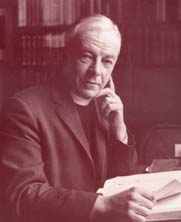
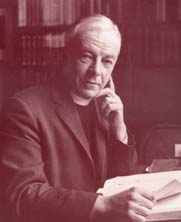
“At a conference in the Pollock Halls, attended by members of the Presbytery of San Francisco, he gave an address of Jesus’ use of imagination in his life and teaching as we encounter them in the Gospels. Here for me was the clue to his own preaching and teaching that I had missed all these years. For I have known expository preaching which was dull in excess, being little more than flat commentary; as I have known pastorally-oriented preaching which did not rise above counseling. But, by the use of imagination, Dr. Stewart gave exposition and pastoral perception new power and relevance. As he described so graphically the situation of the biblical passage, he gradually incorporated his hearers in the situation. They so became part of it that they identified with the persons of whom, or to whom, Jesus was speaking. The nearest analogy I know is the ability of a great artist to draw the viewer into the action he is portraying.
But there was more. It was not merely an exercise in empathy. Embodied in the situation, the hearers could not escape the urgency of the words of Jesus directed to them. The Gospel appeal, or challenge, or invitation, was not a codicil [i.e., supplement] to the descriptive passages going before. Each one of them was an integral – an inescapable – part of the whole presentation, directed at each listener.” (7)
Sunday, July 22, 2007
Preaching and Imagination
Tuesday, July 17, 2007
James Stewart and the Missionary Church

“no church is anything more than a pathetic pietistic backwater unless it is first and fundamentally and all the time a world missionary church.”
Friday, September 22, 2006
Stewart on Preaching the Good News

I have come across another old book of sermons by James S. Stewart, the prominent Scottish preacher of the mid-20th century. I have previously posted quotes from his book on missions (first post; second post; third post).
This book, The Strong Name, was published in 1941 so I imagine the sermons were originally preached in the early days of WW II. This seems to be the point in the opening of his sermon “The Romance of Orthodoxy.” Preaching from 2 Kings 7:9 he rebukes the idea which was apparently (and understandably) current then that “these are bad days and not time for the announcing of good news.” Stewart rebukes such an idea for the church by pointing to the Gospel. No matter our situation we have been loved and redeemed by God! Stewart closes the sermon with the following words which are a good exhortation to us in any day. Perhaps it is especially good as we approach Sunday and many of us will be preaching. Proclaim the Gospel, brothers!
If the Church were witnessing with all her might, and in all her members, to the things which she most surely believes and by which she lives, how incalculable might be her achievement in this perplexed, distracted generation! If we, the children of Zion whose captivity God has ended, had our mouths filled with singing for the gladness of that great deliverance, what threatening shadows might be scattered, what dark and dreary places flooded with the blessed light of hope! If every professing Christian were a veritable ambassador of Christ, how the royal banners of His Kingdom would go from strength to strength, conquering and to conquer! This is a day of good tidings. One thing is needful. The world cries for it. Honour claims it. Christ commands it. Send the good tidings on!
Amen!
Sunday, November 20, 2005
Update on Stewart Book
Friday, November 04, 2005
Missions Undergirded by Theology, Stewart Again

Returning to thoughts from James Stewart’s great little book on missions, Thine is the Kingdom, Stewart regularly pounds home the theme that our eschatology matters in missions. While there are differences in the realm of eschatology, we must be certain and clear that Christ is reigning now- he is not waiting to reign. Christ reigns. The enemy is still running about; the final, ultimate end of the enemy is yet future; but, Christ reigns. This is important for us to hold on to. Stewart writes:
“Now there is all the difference in the world between going out on mission with the motive of helping Christ to become King, and going out because the King has sent you.” (pg.27)Let us go forth in full confidence that Christ has conquered and now reigns. We go not forth to help Him achieve His victory. We go out because He is victorious, and we call all people to submit to this victorious Christ rather than be conquered as His enemies.
“Knowing that the Kingdom had appeared in time and that Christ was reigning now, they turned to face the future with a new intensity of hope, a hope as certain as the promises of God. Realizing that the decisive battle had been won, they flung themselves with magnificent abandon into the remaining toils and dangers of the campaign, sustained in all the hardships and dangers and persecutions of their mission by the certainty of the coming end, and straining their eyes through the darkness towards the final triumph of the Lord. Each Eucharist was a foretaste of the Messianic banquet and marriage supper of the Lamb.” (pgs.31-32)
“The men of the Bible know and declare that if the powers of darkness have a lot of rope nevertheless the end of the rope is in the hands of God. They see that God in His sovereignty can use even what is pagan and demonic as the agent of His purifying judgment upon Israel and the Church.” (pg.56)
“… the watchword on the banner of the Church’s mission, Christus Victor, represents not a pious hope, but a historic, irrevocable fact.” (pg.73)
Tuesday, October 18, 2005
Stewart Again- Strength in Weakness
Particularly if you find your self discouraged in your ministry as you regularly see reminders of your own weakness, read on. Read on, and be encouraged. Read on, and exult in the God who displays Himself through human weakness. Then rise up in faith that God will manifest His grace through your weakness, and Christ will build His church.
“This is the answer to the disconsolate moods in which, looking at the Church and seeing its crippling, often stupid divisions, its bourgeois complacency, its failures pathetic enough to make the angels weep, we begin to ask—‘Is this indeed the instrument of the mission of Christ? Is this to go out among the heathen as “the arm of Christ’s presence”?’ It is the answer also to the despairing moods in which we turn in upon ourselves: ‘I the ambassador of this royal Jesus? I to wear the Christian name before the world? God pity me—poor earthen vessel—utterly unworthy!’ This is the answer—that always it is upon human weakness and humiliation, not human strength and confidence, that God chooses to build His Kingdom; and that He can use us, not merely in spite of our ordinaries and helplessness and disqualifying infirmities, but precisely because of them. It is a thrilling discovery to make, and it can revolutionize our missionary outlook completely. For clearly, if this fact be true, the Church that believes it can be irresistible anywhere, and its mission for Christ against the powers of darkness becomes bright with an unquenchable hope; and the individual Christian who lives by it is undefeatable. Nothing can defeat a Church or a soul that takes, not its strength, but its weakness, and offers that to be God’s weapon. It was the way of William Carey and Francis Xavier and Paul the apostle. ‘Lord, here is my human weakness: I dedicate it to Thee for Thy glory!’ This is the strategy to which there is no retort. This is the victory which overcomes the world.” (pgs.23-24)
James S Stewart on Missions
“One reason, wrote P.T. Forsyth, ‘why the Church is too little missionary is that it is established on good terms with its world instead of being a foreign mission from another.’ The powers of darkness will never be scattered by a Christendom infiltrated by the enemy …. for only to a Church radically different from the world will the world consent to listen; and the whole cause of the Kingdom of God, now as then, is at stake in that appeal.” (pg.19-20)
This connects with so much I have sought to say (not nearly as well) over the years. The labor for the purity of the church is not separate from the work of missions and is not a drain on the work of missions. It is vitally linked to the work of missions! This also speaks to the desire to look and sound like the culture. While of course we should work to remove unnecessary barriers, we must remember that the church was never supposed to look just like the world. It is the difference which makes a difference.
The title of the book is Thine is the Kingdom. It has been out of print for some time though you can find old copies on the web. I have initiated contact with some publishers and will be having further conversations about getting this book reprinted. I plan to post some more quotes soon, If you think you would be interested in this book being available let me know, and I’ll let these publishers know of grass roots interest.